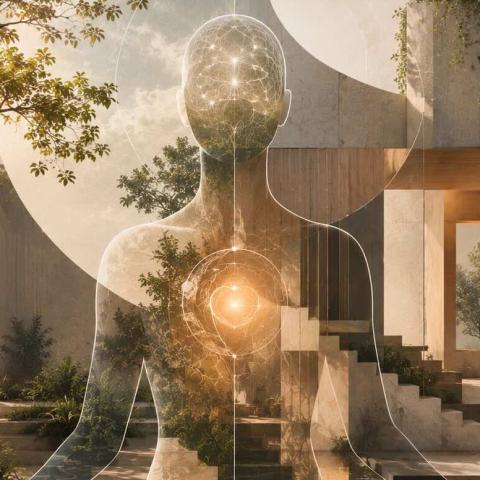
This training provides the foundation for understanding neuroarchitecture and conscious design, and how these fields affect space, perception, and human experience, influencing people's well-being.
This training provides the foundation for understanding neuroarchitecture and conscious design, and how these fields affect space, perception, and human experience, influencing people's well-being.
DATES TO BE CONFIRMED
This course proposes an interdisciplinary approach to the relationship between the individual and the built environment, offering a foundation for understanding the principles of neuroscience applied to architecture from a comprehensive, critical, and non-deterministic perspective.
Spanning five sessions, the course encourages a shift in perspective regarding architectural design by integrating insights from neuroscience, behavioral sciences, health sciences, environmental psychology, and the social sciences. It begins by transforming the concept of the relationship between mind, body, and environment to delve deeper into how we perceive, inhabit, and experience spaces.
The course introduces concepts such as neuroarchitecture and conscious design, alongside notions of health, well-being, and the environment. It also addresses fundamental concepts—including the mind, cognition, perception, and experience—and explores phenomenology as a way to approach the lived experience of space.
The program examines the relationship between the nervous system, the body, and space; the embodied, situated, and active mind; and neurophenomenology as a means of linking lived experience with biological processes. Finally, it considers the individual within their context—incorporating factors such as culture, society, and identity—and concludes with a reflection on the bioethics of design.
This course is designed to broaden perspectives on architecture and build a knowledge framework that allows for an approach to design rooted in the complexity of human experience.
Objectives
- To understand the fundamentals of neuroarchitecture and conscious design from an interdisciplinary and holistic perspective.
- To analyze the relationship between mind, body, the nervous system, and the built environment, avoiding deterministic or reductionist approaches.
- To become familiar with key concepts related to perception, cognition, and the lived experience of space.
- To incorporate the influence of social, cultural, and relational contexts on how people experience and inhabit spaces.
- To reflect on the role of architecture in health and well-being, and on the ethical implications of environmental design.
Target Audience
Professionals interested in human neurophysiological reactions during interactions with natural and built environments—such as those working in architecture, space management, UX design, interior design, decoration, sociology, anthropology, or psychology.
Methodology
Format
Steaming.
Session structure
5 sessions of 4 hours each. 20 hours of theory.
Evaluation
Active course engagement and participation.
Programme
The goal of this training is to build an interdisciplinary framework for understanding the relationship between the individual and the built environment. It integrates knowledge from neuroscience, behavioral sciences, health sciences, environmental psychology, and social sciences, while avoiding deterministic or reductionist approaches.
Key concepts will be analyzed, such as the need to broaden the perspective on architectural design, the shift in how the mind-body-environment relationship is conceived, the definition of human experience, and the influence of social, cultural, and relational contexts on the experience of space.
The following topics will be covered across the 5 sessions:
- Shifting the perspective: a holistic approach.
- Historical context and timeline.
- Introduction to the concepts of "Neuroarchitecture" and "Conscious Design."
- Holistic perspective: defining health, well-being, and environment.
- Basic concepts: mind, cognition, perception, and experience.
- Phenomenology: lived experience.
- The nervous system-body-space triad (I): Embodied, situated, and active mind.
- Neurophenomenology: linking lived experience with biological processes.
- The individual in context: culture, society, identity, and environment.
Design bioethics.



Formación relacionada

Curso | Aplicación y criterios para la descarbonización, la circularidad y el reto climático